Limiting beliefs are recurring assumptions about yourself, other people, or your opportunities that narrow your choices or discourage helpful action. Common limiting beliefs examples include “I’m not good enough,” “It’s too late for me to change,” and “I have to please everyone.”
Noticing a belief does not make it false. Some fears reflect real experiences or real barriers. The aim is to name the belief, check how accurate it is, and build a more flexible response.
This guide gives fifteen examples, a six-step process, and a 15-minute exercise. If you would like a guide for this kind of work, see our personal growth and confidence coaching.
What Are Limiting Beliefs?
A belief is an idea you treat as true, often without checking. A limiting belief is one that keeps you smaller than your situation requires, such as staying quiet in meetings because “my ideas are never good.”
It helps to separate a few things that feel alike:
- Automatic thoughts are quick, passing reactions, such as “that went badly.” A limiting belief is the steadier rule underneath them.
- Self-doubt is a feeling of uncertainty. It becomes a belief when it hardens into “I can’t do this.”
- Habits are behaviors on repeat, like putting things off. They can be fed by a belief but are not the same thing.
- Objective barriers are real: a visa rule, a lack of funds, a closed door. Calling these “just mindset” is unfair and unhelpful.
Where Do Limiting Beliefs Come From?
Usually from several places at once. Past experiences, such as a failed exam or a rejection, can leave a conclusion behind. Family messages (“we don’t talk about money”), social expectations, and repeated criticism add to it.
Many beliefs are simply learned assumptions or a personal interpretation of failure: “I failed, so I am a failure.” Childhood trauma can play a part for some people, but it is not the cause for everyone. Many ordinary beliefs come from ordinary life.
15 Limiting Beliefs Examples
The first eight are in the table, since they share a pattern. Examples 9 to 15 follow with more detail.
| # | Belief | How it shows up | Why it limits | A realistic alternative | One small action |
| 1 | “I’m not good enough.” | Overpreparing, hiding work, discounting praise | You judge yourself against an impossible standard | “I have strengths and gaps, like everyone.” | Write down three things you did well this week |
| 2 | “I always fail.” | Avoiding new projects | One or two setbacks become a rule | “Some things went badly, and some went well.” | List three past successes, even small ones |
| 3 | “I don’t deserve success.” | Turning down promotions, undercharging | You pull back when things go well | “I can earn good things and accept them.” | Accept the next compliment with just “thank you” |
| 4 | “It’s too late for me to change.” | Postponing goals because of age | Time becomes a reason to never start | “Some paths are narrower, but I can still begin.” | Spend ten minutes researching one first step |
| 5 | “Other people are naturally more capable.” | Constant comparison, staying silent | You overlook the practice behind other people’s skill | “Most skills are built by practice.” | Ask someone you admire how they learned it |
| 6 | “If I make a mistake, everyone will judge me.” | Rereading emails, avoiding speaking up | Fear of one slip stops useful action | “Most people notice less than I fear.” | Ask a question in a low-stakes setting |
| 7 | “I have to please everyone.” | Saying yes automatically, resentment later | Your needs always come last | “I can care about people and still have limits.” | Pause for one day before agreeing to a request |
| 8 | “I can’t set boundaries without losing people.” | Over-explaining, avoiding hard talks | Unspoken limits build into distance anyway | “A kind, clear limit can protect a relationship.” | Practice one calm sentence, such as “I can’t this week” |
- “I’m bad with money and always will be.” You may avoid opening statements or put financial decisions off. The belief limits because it treats a skill gap as a fixed trait. A more realistic thought is “I haven’t been taught this yet, and I can learn the basics.” Try tracking one week of spending without judging it.
- “I don’t deserve a healthy relationship.” This can show up as staying with people who treat you poorly, or leaving when things feel calm. It limits because familiar can feel safer than good. Try “I can learn what a healthy relationship looks like.” One small step: write down three qualities you want in a partner or friend.
- “I must be perfect before I start.” Projects stay unfinished and launches get delayed. The limit is that waiting for perfect means you never gather the feedback that helps you improve. A fairer thought is “A rough first version is a useful start.” Set a timer for 20 minutes and produce something imperfect.
- “Asking for help makes me weak.” You struggle alone, then run out of energy. It limits because it cuts you off from the support that makes most hard things easier. Try “Asking is how people get things done.” Ask one person for one small piece of help this week.
- “I can’t succeed because of my past.” You may rule out opportunities because of earlier mistakes or a difficult start. The belief treats your history as a verdict. A balanced view is “My past shaped my starting point, not my whole path.” Choose one skill you can build now, and take the first lesson.
- “My feelings are always a burden.” You hide sadness or worry to avoid being a bother, and relationships feel one-sided. It limits closeness. Try “Sharing a feeling is part of a real relationship.” Tell a trusted person one honest thing about your day.
- “If I try something new, I’ll embarrass myself.” You stay with what you already do well. The cost is a smaller life over time. A realistic thought is “Being a beginner is awkward, and it passes.” Join a beginner class or session once, with no plan to be good at it.
How to Identify Your Own Limiting Beliefs
Start with the sentences you repeat. Listen for “always,” “never,” “I can’t,” “I should,” and “I’m the kind of person who.” Those words often point to a rule instead of a fact.
Then look at triggers. Notice which situations, people, or times of day set the thought off, and what you do right after. Patterns in your choices, such as always declining visible roles, can show a belief at work even when you never say it aloud.
Finally, separate evidence from assumption. Ask: “What do I know for certain, and what am I guessing?” If the self-worth theme feels familiar, our guide on how to build self-worth is a good companion.
How to Release or Reframe Limiting Beliefs
This six-step process draws on ideas used in cognitive approaches, where thoughts are examined as ideas to test instead of facts. The NHS describes cognitive behavioural therapy as questioning unhelpful thoughts and beliefs and considering other perspectives. This article is not therapy, but the same basic logic is useful for everyday reflection.
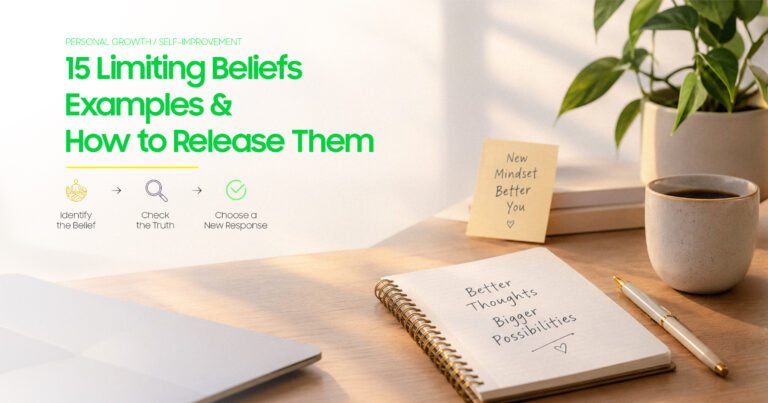
- Identify the exact belief. Write it as a single sentence in your own words.
- Write down when it appears. Note the situation, the people, and the feeling.
- Examine the evidence. List what supports the belief and what challenges it.
- Find a more balanced alternative. Choose a statement you could partly believe.
- Test it with a small action. Pick something that takes 10 minutes or less.
- Review what happened without judging yourself. Note what you did and what you learned. A mixed result is still information.
What Does Not Work
Forcing yourself to think positively tends to backfire. So does tackling five beliefs at once, or blaming yourself for having them. Treating real barriers, such as money or paperwork, as only a mindset problem also misses the point.
Why Positive Affirmations Sometimes Feel Unconvincing
If you tell yourself “I am a total success” while your bank balance and your inbox say otherwise, part of you argues back. An extreme positive can feel false, and the mismatch makes the old belief louder.
A believable alternative sits closer to your experience. Instead of “I am perfect,” try “I am learning, and I handle more than I used to.” Instead of “Everyone loves me,” try “Some people value me, and I can build on that.” You do not have to feel certain. You only need a thought you can test.
How Personal Growth Coaching May Help
Some people find it easier to work through beliefs with another person. A coach can offer structured reflection, supportive questions, accountability, and help turning a goal into steps. Hearing your own words said back can show a pattern you could not see alone.
Coaching is not licensed mental health treatment and does not replace it. It suits people who want to clarify goals and build confidence. You can read about how we approach this on our coaching page.
Some readers also look at spiritual practices alongside reflection. Our explainer on what Theta Healing is covers one belief-focused approach, with its limits, and the guide to how to cleanse your aura offers a short grounding routine if reflection leaves you unsettled.
When Professional Support May Be Useful
Reach out to a doctor, psychologist, or counselor if your thoughts come with severe distress, symptoms linked to past trauma such as flashbacks or panic, or a pattern that interferes with sleep, work, or relationships for weeks. The same applies if you feel hopeless or think of harming yourself.
Thought records are a gentle tool. They are not a substitute for care when something is more serious. If you already have treatment, keep it in place.
Try This Practice: A 15-Minute Limiting-Belief Thought Record
Goal: Identify one belief, test it against evidence, and choose one manageable action.
Time required: 15 minutes, plus a pen and paper.
- Write the situation that bothered you recently, in one sentence. (2 minutes)
- Write the belief behind it, word for word. Rate how strongly you believe it, from 0 to 100. (2 minutes)
- Note the feeling and the body reaction. (1 minute)
- List evidence that supports the belief. (2 minutes)
- List evidence that challenges it, including exceptions. (3 minutes)
- Write a balanced alternative you could partly believe. Re-rate your original belief. (3 minutes)
- Choose one small action to test the alternative this week. (2 minutes)
Sample completed entry
- Situation: I did not speak in the team meeting.
- Belief: “If I say something wrong, everyone will judge me.” (80)
- Feeling: Tight chest, embarrassment.
- Evidence for: Years ago, a colleague corrected me in front of others.
- Evidence against: Most of my comments have been fine, two colleagues have asked for my view, and mistakes in this team are usually fixed without comment.
- Balanced alternative: “I might say something imperfect, and that is survivable. Most people are focused on their own points.”
- Re-rated belief: 55.
- Small action: Offer one short comment in Thursday’s meeting.
Test of progress: You named a belief, wrote a balanced alternative, and chose one manageable action. A lower belief rating is a bonus, not a requirement.
A realistic next step: Do the action, then repeat the record for the same belief next week. Beliefs usually shift in small steps, so do not expect an instant emotional change.
Frequently Asked Questions
What are common limiting beliefs?
Common ones concern worth (“I’m not good enough”), ability (“I always fail”), timing (“It’s too late”), and relationships (“I have to please everyone”). The fifteen above are a starting list.
How do I identify my limiting beliefs?
Listen for repeated phrases like “I always” or “I can’t,” and notice what you avoid. Writing down the thought behind a recurring feeling is the quickest way to see it.
Can limiting beliefs change?
Yes, for many people, especially when they are tested against real experience. The change is often gradual and partial.
How long does it take to change a limiting belief?
There is no standard timeline. A mild belief may loosen in weeks of regular practice, while one with deep roots may take longer or need professional support.
Can coaching help with limiting beliefs?
It can help with reflection, goals, and accountability. It does not replace mental health treatment when that is needed.
One Belief, One Small Change
You do not have to take on all fifteen. Pick the one that showed up most often in your own life, or the one that made you wince a little as you read it.
Work with that single belief for a few weeks. Write it down, test one balanced alternative, and note what happens. A small, honest change tends to hold better than a big one that lasts a weekend.
If you would like support, you can book a free consultation to talk through where to start.