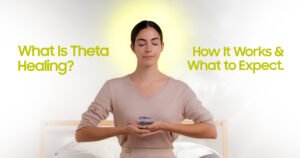
What is Theta Healing? It is a spiritual and meditative practice in which a practitioner guides you through focused relaxation, intuitive work, and a conversation about your personal beliefs, with the aim of shifting patterns you feel are holding you back. Practitioners present it as work with the mind and spirit, not as a medical treatment.
If you have seen the name on a wellness menu, you may be wondering what actually happens, whether it is safe to try, and what the evidence says. This guide explains the method as practitioners describe it, keeps belief and research apart, and covers what to ask before you book.
This is a general explainer. If you would rather read about guided support offered here, explore our energy healing approach.
What Is Theta Healing, and Where Does It Come From?
Theta Healing was created by Vianna Stibal, who began teaching it in the 1990s. The name is a registered trademark, and practitioners are trained through courses run by the founder’s organization, the ThetaHealing Institute of Knowledge.
Practitioners commonly describe the method as meditation combined with prayer. Many say the work involves a connection with a higher power, which they may call Creator, Source, or God. They also say it is open to people of any religion or none.
That description comes from the practice’s own community, so it is not independent evidence about whether the method works.
How Theta Healing Works, as Practitioners Describe It
Practitioners usually describe four overlapping parts. None has been verified as a mechanism by independent research, so read this as a description of the practice, not an explanation of biology.
Relaxation and intention. A session starts with you saying what you want to explore, such as a pattern of self-doubt, worry about money, or a wish for more calm. The practitioner then guides your breath and attention, often with a short meditation or prayer. Practitioners say this creates a receptive state.
Belief exploration. The central idea is that deeply held beliefs shape feelings and choices. The practitioner asks questions to find a belief such as “I have to struggle to be loved.” Some use muscle testing, where light pressure on an arm is read as a yes or no. Independent reviews have not found it a reliable way to detect beliefs, so treat it as ritual, not measurement.
Visualization and intuitive work. Practitioners describe imagining a belief being released and a new one taking its place, often with spoken statements. Some say they receive intuitive impressions about your situation. These impressions are personal and cannot be checked from outside.
Reflection. The session ends with a conversation about what came up, and often a suggestion to notice changes over the following days. Trained practitioners say changes are made only with the client’s permission.
What Theta Brainwaves Are, and What They Do Not Prove
In neuroscience, theta waves are a pattern of electrical activity in the brain, usually defined as roughly 4 to 8 cycles per second. They are recorded with EEG, sensors placed on the scalp. Theta activity appears during drowsiness, light sleep, some meditation, and certain memory tasks. It is a normal part of brain function, not a healing switch.
The practice borrows the name because practitioners say a session involves a deeply relaxed theta state. But a label is not a measurement, and the existence of theta waves does not show that a session heals anything.
There is at least one direct test. A small 2016 study in the Journal of Alternative and Complementary Medicine recorded EEG from ten healers and ten clients during ThetaHealing sessions. Theta activity did not increase, and one theta band decreased significantly in the healers. The authors noted that this says nothing about whether the method is clinically useful. It only means the claim about increased theta waves was not confirmed.
So it is not safe to assume that a particular brainwave state occurs in every session.
What Happens During a Theta Healing Session
Methods differ between practitioners, and sessions are often reported to last between 30 and 90 minutes. Here is a common shape.
- Initial discussion and intention. You talk about what brought you and what you would like to explore.
- Guided relaxation or meditative focus. You sit or lie comfortably, usually fully clothed and awake. The practitioner may lead slow breathing, a short meditation, or a prayer.
- Exploration of feelings or beliefs. Through questions, you and the practitioner look for a recurring feeling or belief linked to your intention.
- Visualization, intuitive guidance, or belief-focused work. You may be invited to imagine releasing a belief, repeat statements, or hear impressions the practitioner says they receive.
- Reflection and integration. You talk through what you noticed and agree on anything to try afterward, such as journaling.
Some practitioners work by phone or video and add their own rituals. Ask what to expect before your first session.
Why People Try Theta Healing
Most people give reasons that are about reflection more than cure: time to think about a recurring belief, emotional clarity during a hard season, deep relaxation, personal growth, or spiritual connection.
The Theta Healing benefits people describe are personal: a calmer mood after a session, a clearer view of a repeating worry, or a sense of meaning. These are experiences, not clinical outcomes, and nobody can promise them.
Relaxation and reflection are worth having in their own right, and they can also come from a quiet walk or a talk with someone you trust. Our page on holistic healing explains the approaches we work with.
What Does the Research Actually Say?
It helps to separate two questions: meditation and relaxation in general, and Theta Healing specifically.
For the first, the US National Center for Complementary and Integrative Health summarizes the science in 8 Things to Know About Meditation and Mindfulness. It says mindfulness-based practices may help with anxiety and depression, may improve sleep, and have produced mixed results for pain. It also says these practices are usually considered low risk, although some people have negative experiences.
That evidence concerns mindfulness programs. It does not carry over automatically to Theta Healing, which adds prayer, belief work, and intuitive elements those studies did not test.
For the second question, the EEG study did not confirm the theta claim, and we could not find independent clinical trials showing that Theta Healing treats physical illness or a mental health condition. That leaves the question open, so claims should be modest.
What Might Someone Feel During or After a Session?
Experiences vary widely. Some people feel relaxed or sleepy, some feel emotional, and some feel calm, neutral, or unsure about an unfamiliar process. All of these are ordinary.
An emotional reaction does not prove that a belief was cleared or that anything physical changed, and feeling nothing does not mean you did it wrong.
If distress lingers after a session, talk to someone you trust or a qualified professional. If you want a gentle way to settle afterward, our guide to how to cleanse your aura describes a short grounding routine.
How Theta Healing Differs From Other Practices
These approaches overlap in tone, but they are not interchangeable.
| Practice | General approach | Practitioner’s role | Evidence base |
| Theta Healing | Guided relaxation, meditation or prayer, and belief-focused work with an intuitive element | Facilitator who follows a trained method and shares intuitive impressions | Practitioner and client reports. One EEG study did not confirm the theta claim |
| Meditation | Training attention or awareness, often self-guided | Teacher or guide, while you do the practice | Research suggests possible help for anxiety, low mood, and sleep, with mixed results for pain |
| Reiki or energy healing | Hands-on or hands-near practice meant to balance an energy field | Practitioner who directs or channels energy | Mostly practitioner and client reports. The energy field itself has not been scientifically demonstrated |
| Professional psychological therapy | Structured talking treatments such as cognitive behavioural therapy | Licensed clinician who assesses and treats | Large body of clinical research for many conditions |
Psychological therapy is designed to assess and treat mental health conditions. The other three are explored for relaxation, reflection, or spiritual reasons, and should sit alongside medical or psychological care, never replace it.
What Does Not Work, and Why
Expecting an instant cure. Some marketing claims healings happen in seconds. No evidence supports instant cures of illness, and that expectation can lead someone to delay care they need.
Relying on one session for a complex concern. Long-standing worry, grief, relationship patterns, and chronic symptoms rarely change after one conversation. They usually need time, practical changes, and often professional input.
Reading emotion as proof of a biological effect. Tears, warmth, and lightness are real feelings, but slow breathing, quiet, and a caring listener produce them too. They do not show that a physical change took place.
Replacing treatment. No spiritual practice should stand in for medication, therapy, or medical care. If a practitioner suggests stopping any of these, step away and speak with your doctor.
What to Ask Before Booking a Session
A short conversation before your first visit tells you a lot.
- How were you trained, and can I verify your certification with the organization that issued it?
- What will happen in the session, and what will you ask me to do?
- How do you handle consent, and can I stop at any point?
- What do you say the session can and cannot do? Walk away from any promise of a cure.
- How do you work alongside my doctor or therapist?
- What are the fees, session length, cancellation terms, and how many sessions do you suggest?
You should never be pressured to share more than you want, touched without agreement, or pushed to recall memories you do not have.
Try This Practice: A 12-Minute Belief Reflection
Goal: Settle your attention and put one recurring belief into words.
Time required: About 12 minutes. You need a timer, paper, and a pen.
- Set a timer for 12 minutes and silence your phone.
- For three minutes, breathe slowly: in through the nose for four counts, out through the mouth for six. When your mind wanders, return to the breath without scolding yourself.
- For one minute, ask yourself what thought keeps returning when you feel stuck or anxious. Write it as one sentence, the way it sounds in your head, such as “I am not allowed to rest.”
- For two minutes, write down when it shows up: which situations, people, and times of day.
- For three minutes, write the evidence for the belief, the evidence against it, and what you would say to a friend who held it.
- For two minutes, write a more balanced version you could partly believe, such as “I need rest too, and I can rest without losing my place.”
- Take one minute to breathe slowly and choose one thing to notice over the next few days.
What to notice: Any change in body tension, whether the belief felt familiar, and whether the balanced version felt believable or forced.
Success test: You named one belief in a single sentence, wrote one balanced alternative that feels at least partly believable, and picked one thing to watch for. Feeling no dramatic shift is normal.
A realistic limitation: This is a reflection exercise. It is not a Theta Healing session and not therapy, and one round will not resolve a long-standing pattern. If it stirs strong distress, stop and speak with a qualified professional. For more on examining beliefs, see 15 limiting beliefs examples and how to release them.
Frequently Asked Questions
What is Theta Healing used for?
People use it for self-reflection, relaxation, and spiritual connection. It is not an established treatment for any medical or mental health condition.
Is Theta Healing scientifically proven?
No. The one EEG study we found did not confirm that sessions increase theta activity, and we found no independent trials showing it treats illness.
Will I lose control or be hypnotized?
Practitioners say clients stay awake and aware throughout. You can pause or stop at any time, and you should leave any session where you feel pressured.
Is Theta Healing the same as meditation?
Not exactly. It uses meditation and prayer but adds practitioner-led belief work and intuitive impressions. Meditation can be done alone, costs nothing, and has a larger research base.
Can beginners try Theta Healing?
Yes. No experience is needed. If you live with a medical or mental health condition, tell your clinician and keep your treatment in place.
Understanding Before Experiencing
Curiosity about practices like this is reasonable. You do not have to believe in them to learn how they work, and you do not have to dismiss them to ask for evidence.
A grounded approach is simple: expect reflection and relaxation, not a cure; ask questions before you book; and keep your medical and psychological care as it is. If a session leaves you calmer or clearer, that experience is worth valuing.
If you would like to talk through your options, you can book a free discovery call to discuss energy healing and holistic support at Soul N Purpose.